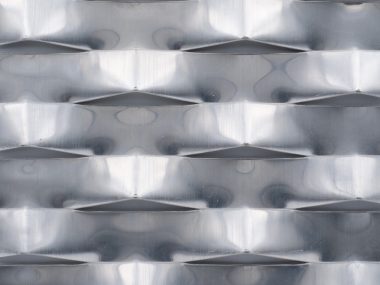
Aluminium is a material with extraordinary characteristics: it is light, resistant and incredibly versatile. It is no coincidence that it is the most widely used metal in the world after steel. Its widespread use is due to its many properties, which make it suitable for a wide range of applications in very different sectors.
Today, aluminium is used in numerous industrial fields: from transport to construction, from packaging to mechanical engineering and even in the electrical engineering sector. We encounter it in our daily lives in the form of thin sheets, car bodies, kitchen utensils and bottles, but also as a semi-finished product for the production of sheet metal, tubes and profiles. In the automotive sector, for example, its use allows for the manufacture of lighter vehicles, thus helping to reduce fuel consumption.
One of the most appreciated qualities of aluminium is its excellent recyclability. With proper separation of materials, it can be recovered and reused 100% without losing its original characteristics. It is therefore not surprising that around one third of all aluminium produced in history is still in circulation today. This makes it a highly valuable material from both an economic and environmental point of view.
From a chemical and physical point of view, aluminium has a number of unique properties: it has a very low density, is an excellent conductor of heat and electricity, is non-magnetic and non-toxic. Furthermore, in its pure state, it has a high reflective capacity. When in contact with air, a layer of oxide forms spontaneously, protecting it and giving it good resistance to corrosion in normal atmospheric conditions. However, environments with high concentrations of chlorides, such as coastal areas, can reduce this resistance. The composition of the alloy used allows its response to external agents to be modulated.
Aluminium also offers numerous processing possibilities. It can be coated using various techniques, such as galvanisation, enamelling, painting, lamination, powder coating or thermal spraying. One of the most common treatments is anodising, a process that further improves its resistance and appearance.
In summary, aluminium is a modern and indispensable material, appreciated for its combination of lightness, durability and sustainability, characteristics that make it a key player in many sectors of industry and everyday life.
The main source of the description
Material-Archiv. (2024). Aluminium.
The source of characteristic values
Merkel, M., & Thomas, K.-H. (2008). Taschenbuch der Werkstoffe (7., verb. Aufl.). Hanser.