
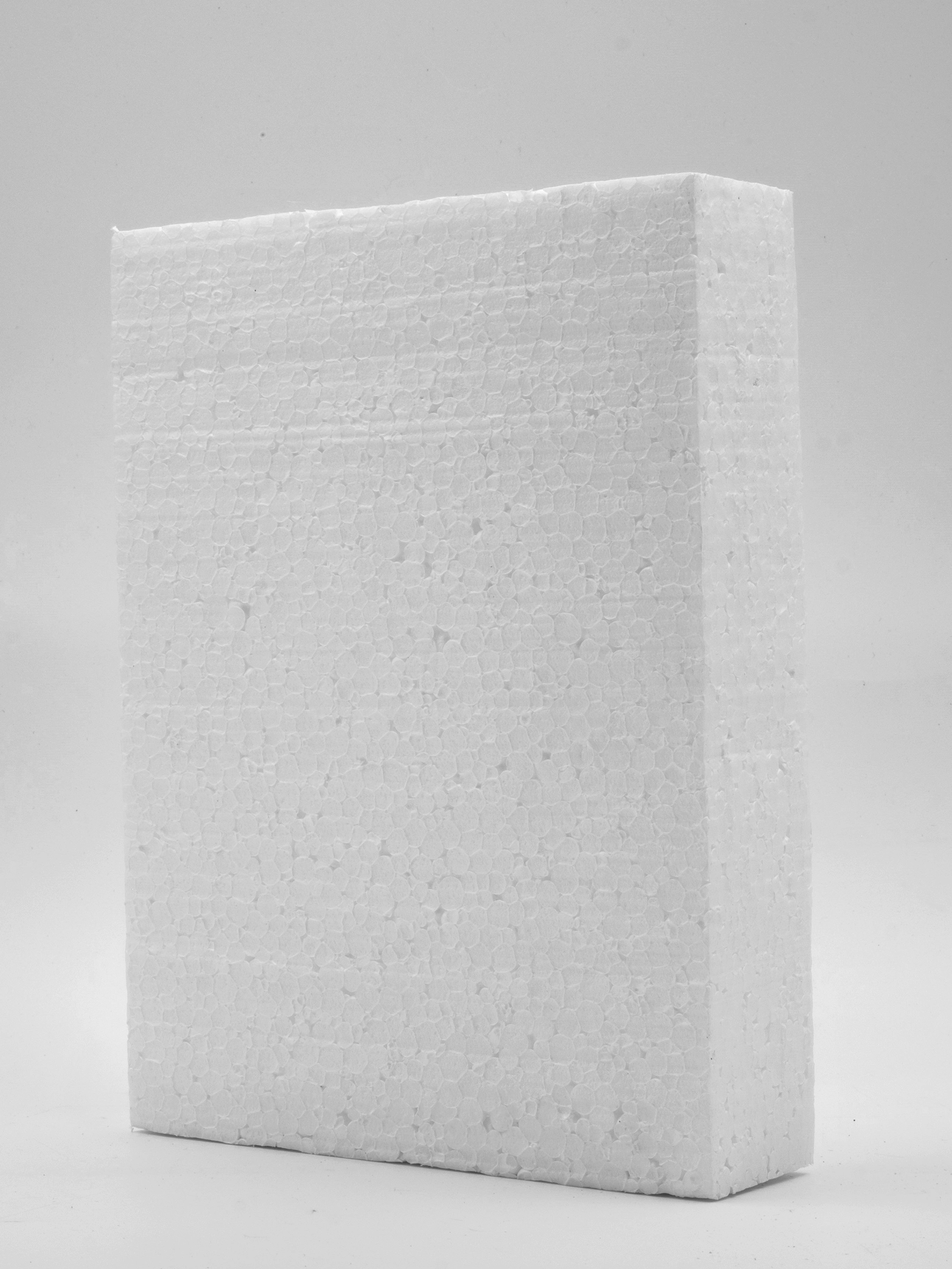
Expanded polystyrene (EPS) is a very lightweight material consisting largely of air. It is produced from small polystyrene beads which, when exposed to steam heat, expand significantly in volume. During this process, the beads bond together to form compact blocks that can then be cut into sheets or moulded into various shapes.
One of the main characteristics of EPS is its ability to insulate against heat and cold. In addition to this, it absorbs noise and cushions impacts, which is why it is often used as protective packaging. It absorbs very little water and allows very little vapour to pass through, making it suitable for environments where it is important to limit humidity.
The consistency of the material can vary: increasing the amount of polystyrene in the initial mixture produces a stiffer product, whilst using less results in a softer one.
Thanks to these properties, EPS is particularly widespread in the packaging sector, where it is used as shock protection and thermal insulation. It is also found in applications such as the padding of sports helmets.
A significant limitation is its poor resistance to UV rays: if exposed to the sun for long periods, the material tends to deteriorate, becoming brittle and crumbly.
Main source of the description
Material-Archiv. (2024). Polystyrol, expandiert (EPS).
Other sources
Hegger, M. (2006). Atlante dei materiali. UTET.